 At 9 years old, after 4 years of piano lessons, I got a new teacher. Her name was Mrs. Hicks, she kept a dish of hard candy on her piano, she had the brightest red hair I’d ever seen (until I began to rival it myself), she was the nicest lady you’d ever meet, and she was terrifying. On my first day with her, she took a cursory look at my books, had me play the piece I’d been working on with my previous teacher, and walked out of the room. When she returned, she thrust a piece of sheet music into my hands — “The Rose,” as I recall — and said, “You will be play this. It will be difficult, and you will not like it — or me, at times — but you will play it and be better for it. But first, you will play these.” And she placed three more books on the bench beside me.
I spent the next hour stumbling through exercise after exercise, my fingers tangling through combinations they’d never played, my brain making sense of more symbols than it was used to. When my mom picked me up, I slumped down in the seat of the car, crossed my arms, and proclaimed I no longer wanted to play the piano. I didn’t need silly exercises, I said. I just needed to play. It had been working for 4 years. Why change it?
My mom, of course, laughed — which is exactly what I did the first time someone said to me, in complete shock, “What do you mean you never use writing prompts? How do you practice?”
“Well,” I replied, “I just write.”
The truth was, though the concept of practice to hone a craft wasn’t foreign to me — my first major in college was piano, after all — it had never occurred to me to practice writing. I mean, wasn’t that what first, second, third, and tenth drafts were for? So I laughed it off… until I woke up in the wee hours of one morning, absolutely panicked that I hadn’t added an idea to my trusty notebook in over 2 years. Until I realized that I’d been writing the same ideas over and over and over. Until I got stuck in the middle of a National Novel Writing Month event without a clue what my characters could do that wouldn’t make even me fall asleep. Enter a prompt. And my writing world changed.
The problem many writers have with devoting time to prompts is that they often take precious writing time away from current projects. Away from the projects we want to send out into the world to mark our place in it. But the truth is, if we want to leave a legacy of words worth reading, we have to practice. Just as I had to stretch my fingers and my brain to eventually master “The Rose” — which I did in about 6 months — we, as writers, have to get out of our comfort zones, stretch our imaginations, and hone our skills. That’s where prompts come in.
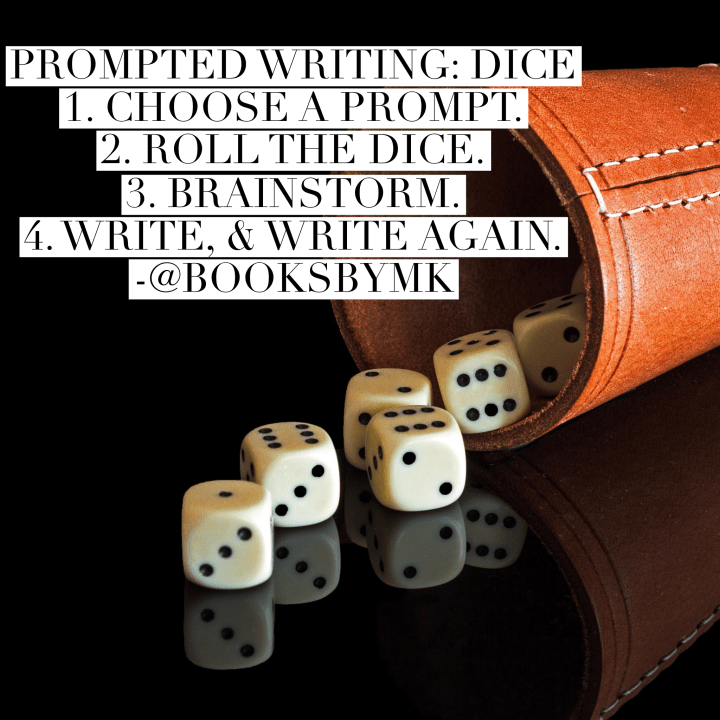
But how do you actually use a prompt? Do you just pick a little piece of inspiration and start writing? Maybe. But personally, to challenge myself and get the most out of whatever prompt I choose, I like to use what I call The Dice Method (creative, eh?).
For this method, you’ll need:
— 2 standard, 6-sided dice (or, if you want to get crazy, grab a couple of multifaceted gaming dice)
— A list of POV styles (e.g., first, second, third, limited, objective, omniscient, etc.) corresponding with each number on one die.
— A list of techniques (e.g., dialogue, exposition, description, etc.) corresponding with each number on one die
— A writing prompt of your choice
— A timer
— Something to write with (i.e., pen, pencil, paper, laptop, etc.)
Okay, you have your materials. Now, it’s time to write.
First, roll the dice. This is how you’ll determine what POV and what technique you’ll be practicing. For instance, using my examples in the equipment list above, rolling a 3 and a 1 would mean you’ll be concentrating on dialogue (technique) in third person (POV).
Now, set your timer because it’s time to brainstorm. In my opinion, one of the easiest ways to do yourself a disservice when working with prompts is to take the obvious path. Why? Because that’s going to be the comfortable path, and you’re trying to step out of your comfort zone. So, set your timer. Personally, I like 15 minutes, but the amount of time is really up to you. While your timer is ticking down, think. Jot down ideas. Anything goes. Maybe an unwanted inheritance is mentioned in your prompt. If your first thought is a cursed object, jot it down, but keep going. Don’t stop until the timer goes off.
Now that you’ve jotted down your ideas, look at your list. Remember that cursed object? It’s nice, but it’s your comfort zone. What else do you have? Maybe your protagonist has inherited a disease, maybe she’s inherited a house in a remote location where she’d never want to live, maybe he’s inherited “the short gene” and can’t get his crush to notice him. Find the idea that’s furthest from your comfort zone but still something you might be able to run with. That’s the one you want.
Now, it’s time to write. Compose a loose outline, make detailed notes, wing it. The choice is yours. Just remember to stay in your POV and concentrate on the technique you’ve rolled. If you’ve placed added constraints on yourself — such as a word count range or the use of a particular plot device — keep those in mind, as well. And once you have your first draft, do what you’d do with any other piece: revise it.
When you have a finished product, congratulate yourself on your strengths, and make note of your weaknesses. Then pick a new prompt, do it all over again, and do it often — because just like I needed practice to master “The Rose” and become a better pianist, we all need to practice and master a myriad of skills to become better writers.
Happy writing!
Melanie
 Necessary Fiction